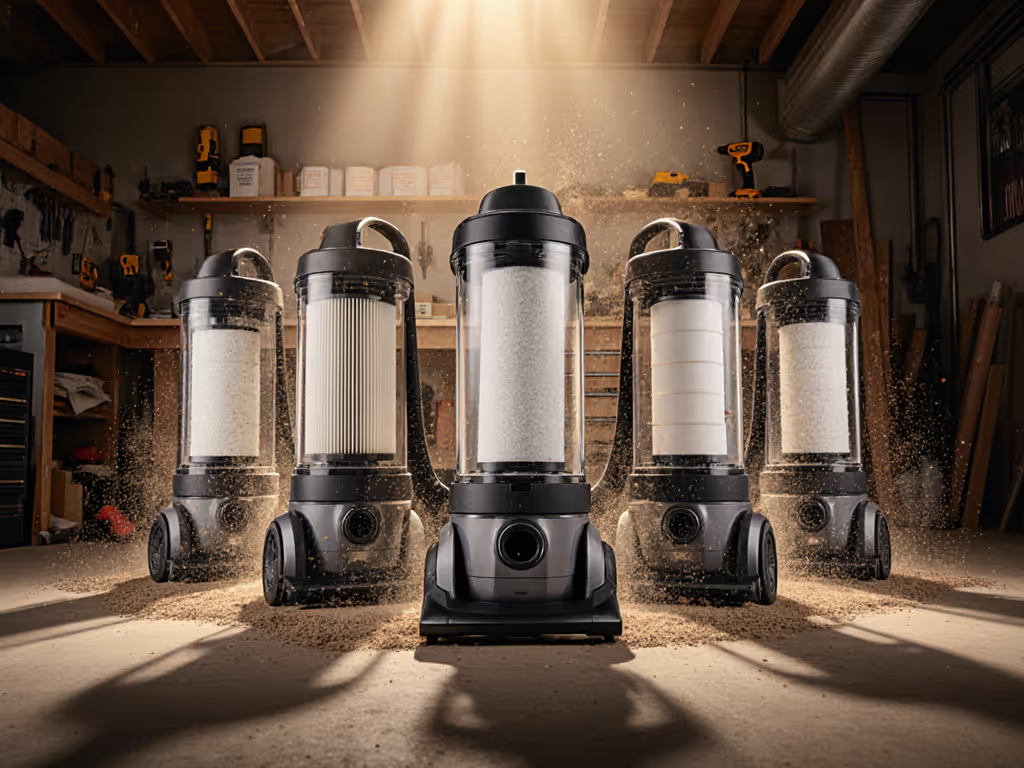

Smart Shop Vacs Ranked: Connected Features vs Performance
By Marco Nguyen • 12th Apr
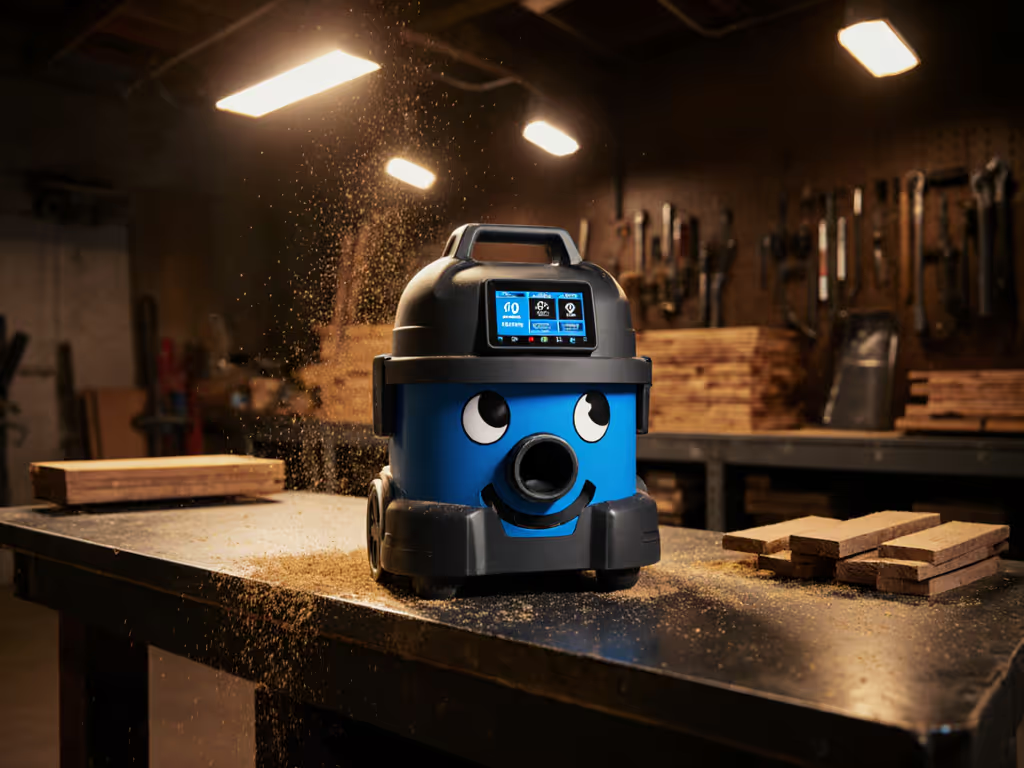
The pitch sounds seductive: the "best" shop vacuum that texts you when the filter needs cleaning, syncs with your tools, logs every cleanup, and integrates with your workshop ecosystem. But after years of testing vacs against actual messes (silica, drywall dust, slurry), I've learned that connected vacuum technology without proper sealed suction, CFM, and filtration is just expensive hardware looking for a problem to solve.
Here's the tension: IoT features are proliferating, but job sites don't care about your phone. They care whether suction holds at 60 inH2O (4.2 kPa) sealed, whether your filter stays clean long enough to finish the demo without clogging, and whether the hose diameter matches your tool. Airflow math beats marketing when the mess fights back.
Below, I've ranked what matters in connected vacuum technology against what actually keeps your rig from choking, leaking, or costing you a callback. The weakest link sets the system, and for most shops that link isn't Bluetooth; it's CFM recovery, filter media, and hose geometry.
1. Raw Sealed Suction vs. "Smart" Pressure Monitoring
Some newer systems brag about digital pressure sensors that alert you via app when suction drops below a threshold. Sounds useful. But here's the problem: if your vac is rated for 120 CFM at 6.5 HP with a standard cartridge, and you're 30 feet downline through a 1.25-inch (32 mm) hose pulling drywall mud, you'll lose ~18-22 CFM before the app even loads. The sensor catches the symptom, not the cause.
What matters instead: a sealed baseline of at least 95-110 inH2O on a 60-80 CFM unit for fine dust, or 120+ inH2O on a 100+ CFM rig for slurry and debris. This isn't a marketing number. It is measured under load with a calibrated manometer. Digital alerts are nice, but a quality pre-separator and the right hose diameter (1.5 inches / 38 mm or larger for runs over 20 feet) prevent the collapse in the first place. To cut filter loading before it starts, see how cyclone dust separators work.
2. App-Controlled Auto-Start vs. Reliable Tool Trigger Integration
Wireless app start sounds premium. Reality check: WiFi cuts out on job sites, Bluetooth range dies in metal buildings, and your phone battery won't outlast your job. More critically, if your connected vac's auto-start fails because the app crashed, you've lost your trigger link to your power tool.
The real win is mechanical tool-trigger or hardwired remote start (proven, no batteries, no auth tokens). Test compatibility first: verify your sander, grinder, or saw trigger voltage matches the vac's auto-start input (typically 24V DC or 110V AC). If it doesn't, you're rewiring or buying an adapter. The best integrations (RIDGID, Milwaukee Packout ecosystem, DeWalt) use rigid connectors and documented pinouts. Skip the app start until it runs offline-first, with fallback to manual.
3. IoT Vacuum Features: Runtime Logs vs. CFM and Sealed Suction Under Load
Some premium units now log job duration, filter life, and power consumption to a cloud dashboard. Contractors love data. But logging hours doesn't tell you whether you actually recovered suction after 4 hours of constant drywall dust.
Instead, track these measurables yourself:
- CFM (Cubic Feet per Minute): baseline and post-filter recovery. A drop below 70% of baseline = time to clean or change the filter.
- Sealed suction (inH2O): initial and after 2 hours of heavy dust. Should hold >=90% of baseline.
- Filter area and media type: a HEPA (High-Efficiency Particulate Air) cartridge rated for your dust class (drywall != concrete != mold).
- Hose diameter and total run length: every 10 feet of 1.25-inch hose costs ~8-12 CFM. Switch to 1.5 or 2 inches (38-50 mm), and recovery jumps 15-25%.
A cheap manometer ($30-50) and a logbook beats an app that can't distinguish a clogged filter from a bad hose. Digital vacuum diagnostics sound smart; measured recovery under your actual dust load is proof.
4. Smart Workshop Integration: Cross-Ecosystem Compatibility vs. Adapter Hell
Marketing promises that your vac "integrates" with your DeWalt, Festool, or Bosch ecosystem. What this usually means: same color, same battery voltage (sometimes), and a generic connector that might work.
The hard truth: tool port diameters vary wildly: 27 mm, 32 mm (1.25 in), 38 mm (1.5 in), 50 mm (2 in). A loose fit means air leaks and zero suction recovery. I've seen remodelers stack three adapters just to connect a vac to a sander, and the final connection wiggled free after 20 minutes.
Verified fitment matters more than brand color. Before claiming integration, confirm: If you’re matching ports across brands, use our vacuum hose compatibility matrix to verify exact sizes and airtight adapters.
- Exact port ID (inner diameter) on your power tool.
- Exact hose OD (outer diameter) on the vac connector.
- Whether a direct fit exists or if you need a step adapter (and whether that adapter is airtight).
If a manufacturer's website doesn't list tolerances and compatible tool models, assume it won't fit your rig without a leak. True smart workshop integration includes a fitment matrix or a 30-day no-questions return.
5. Digital Maintenance Alerts vs. Preventive Filtration Strategy
Connected vacs that remind you to replace the filter sound convenient. Until the notification arrives after you've already clogged the filter and lost 40% suction on a time-sensitive job.
Better approach: know your filter change interval before the job starts. This depends on:
- Filter area: larger = longer intervals. A 1 m^2 cartridge outlasts a 0.5 m^2 sleeve by 2-3x.
- Dust class: fine (silica, drywall) clogs faster than coarse (debris, wood shavings).
- Airflow: continuous high CFM (100+ CFM) clogs faster than intermittent low CFM (40-60 CFM).
- Pre-separation: a cyclone or pre-separator cuts filter loading by 60-80%, extending intervals dramatically.
Plan to change or clean your filter every 4-8 hours in heavy drywall or concrete dust. Not sure which media to run? Compare foam, paper, cartridge, and HEPA filters to match your dust and maintenance window. A calendar and a spare filter onsite beat an app notification that comes too late. If your vac lacks a quick-change design (quarter-turn or tool-free), you're losing 15-30 minutes per swap. That's the real downtime.
6. Connected Flow Rates and Data Logging vs. Sealed Suction Recovery After 2 Hours
A premium connected vac logs CFM and pressure every 30 seconds, feeding real-time dashboards. Great for benchmarking. Useless if the baseline CFM spec is inflated or measured without a hose attached.
The only datapoint that matters on site: sealed suction at 2 hours into heavy dust, measured at the hose port with a manometer, using your actual filter and hose setup. If it holds >=90 inH2O on a 60 CFM rig, you're fine. If it drops to 60 inH2O, your filter is clogged or your hose is kinked. No app needed. Suction tells the story.
7. Predictive Maintenance Alerts vs. Physical Inspection of Seals and Filter Media
Some systems use motor current or pressure trending to predict "failure risk." Clever, but a motor doesn't fail because a sensor predicts it. It fails because seals are cracked, filters are torn, or water got into the motor.
Skip the predictions; do the inspections:
- Weekly: Visually inspect the filter for tears, holes, or color change (white/cream = new; brown/gray/black = dust buildup or saturation).
- Weekly: Check hose for cracks, kinks, and that all connections are hand-tight.
- Monthly: Inspect the motor shaft seal (if accessible) for oil weeping or water intrusion.
- After wet work: drain the tank completely, inspect for rust, and let the motor dry 24 hours.
Predictive software can't replace a 2-minute physical walkthrough. Sealed suction holds because the weakest link holds, and the weakest link is usually a torn filter or a loose hose clamp, neither of which an algorithm will catch before it's too late.
8. App-Controlled Cleaning Cycles vs. Duty Cycle and Filter Class Matching
A few high-end units now offer "scheduled cleaning" or "optimized suction profiles" via app. Gimmick. Suction is suction. CFM and sealed pressure are set by motor and filter. You can't app your way to better airflow.
What does matter: matching your duty cycle to your vac's design. A single-motor, continuous-run unit with a 100 CFM cartridge is built to run 8+ hours daily with scheduled filter taps. A dual-motor auto-start vac is built for intermittent use (power tool triggered, 5-10 minute bursts). Try running the latter continuously, and the motor overheats or the capacitor fails.
Before buying a "smart" vac, verify:
- Rated duty cycle: continuous, 50% intermittent, or duty-rated (e.g., 100 CFM at 75% load factor).
- Filter media class: HEPA (silica, mold), standard cartridge (drywall, general dust), or foam (wet or heavy debris).
- Thermal protection: does the motor cut if it hits 70 C, or does it just run till it fails?
The smarter choice: a simple, robust unit with the right filter for your mess and a pre-separator to extend filter life. Dial in the system, not the smartphone.
9. Multizone Pressure Monitoring vs. Hose Diameter and Length Optimization
Advanced connected systems track pressure at multiple points: tank, motor, hose outlet. Real-time diagnostics. But multipoint data doesn't change the physics.
Here's what I measure in the field:
- Tank pressure: should be 0-2 inH2O under load (hose sealed at end). Higher = clogged inlet, blocked pre-separator, or a filter ready to burst.
- Hose outlet pressure: always lower than tank. A 50-foot run of 1.25-inch hose pulling 80 CFM will see a 15-20 inH2O drop. Switch to 1.5 inches (38 mm), and you recover 8-12 inH2O.
- Tool-side suction: measured at the sander or drill chuck. This is what matters. If it's <60 inH2O at the tool, dust control fails, regardless of tank pressure.
Monitoring all three is nice, but the fix is always the same: shorten the hose, go larger in diameter, or add a pre-separator. An app can't change hose physics. Learn exactly how hose length and diameter affect suction and plan your runs accordingly. Focus on the run length and diameter before you buy; that's where suction is won or lost.
10. Integration Ecosystems and Resale Value vs. Durability and Total Cost of Ownership
Brand ecosystems (Milwaukee One-Key, DeWalt Flexvolt, Festool Systainer) promise unified batteries, auto-start, and resale value. Attractive for contractors building a fleet. But ecosystem lock-in means a failed app, discontinued service, or a proprietary connector could leave you with an orphaned vac in 5 years.
The pragmatic play: buy a proven, modular unit with widely available filters, adapters, and hoses. RIDGID, Craftsman, and Shop-Vac have been around 20+ years; replacement parts are cheap and accessible. A fancy connected rig that depends on cloud login or proprietary firmware updates is a liability if the company shuts down the service.
Calculate total cost of ownership over 5 years:
- Initial cost.
- Filter/bag costs ($15-40 per change x 6-10 changes per year = $90-400 annually).
- Hose and adapter replacements ($50-150 annually).
- Repair/warranty labor (none if it's solid; $200-500 if it's fragile).
- Downtime cost if the vac fails mid-job (priceless).
A simple, sturdy 6-8 gallon wet/dry unit with a cartridge filter and a pre-separator will outlast most connected systems and cost a third as much over 5 years.
What to Do Next: Build Your Spec Sheet Before Shopping
Instead of chasing app features, answer these questions first:
- What's your primary mess? Drywall dust, concrete silica, fine wood flour, wet slurry, or mixed? This sets your filter media class.
- How long is your hose run? If >30 feet, you need 1.5-inch (38 mm) hose minimum and a pre-separator to recover CFM.
- What are your tool port sizes? Measure twice. List every power tool's port ID (27 mm, 32 mm, 38 mm, 50 mm) so you can verify fitment before buying.
- Do you need HEPA/compliance? If silica is in the mix or OSHA applies, specify HEPA media and sealed bag disposal; don't guess.
- Duty cycle and daily hours? If you run 6+ hours daily, buy a continuous-rated motor and a large filter (>=1 m^2). If you're on-and-off, a 60 CFM intermittent unit works fine.
- Budget for the system, not just the vac. Include hose, adapters, filters, and a pre-separator. A $200 vac + $400 in supporting kit beats an $800 "smart" vac + $50 in junk adapters.
Once you've answered those six, the best vac for you becomes obvious. It's probably not the one with the most app features; it's the one with the highest sealed suction for your mess, the simplest hose connections to your tools, and the easiest filter swaps. Measure, fit, test, then deploy. The weakest link sets the system. Make sure it's your choice, not a marketing department's.
Related Articles