Vacuum Hose Compatibility Guide: Port Matching Matrix
By Hana Kobayashi • 23rd Feb
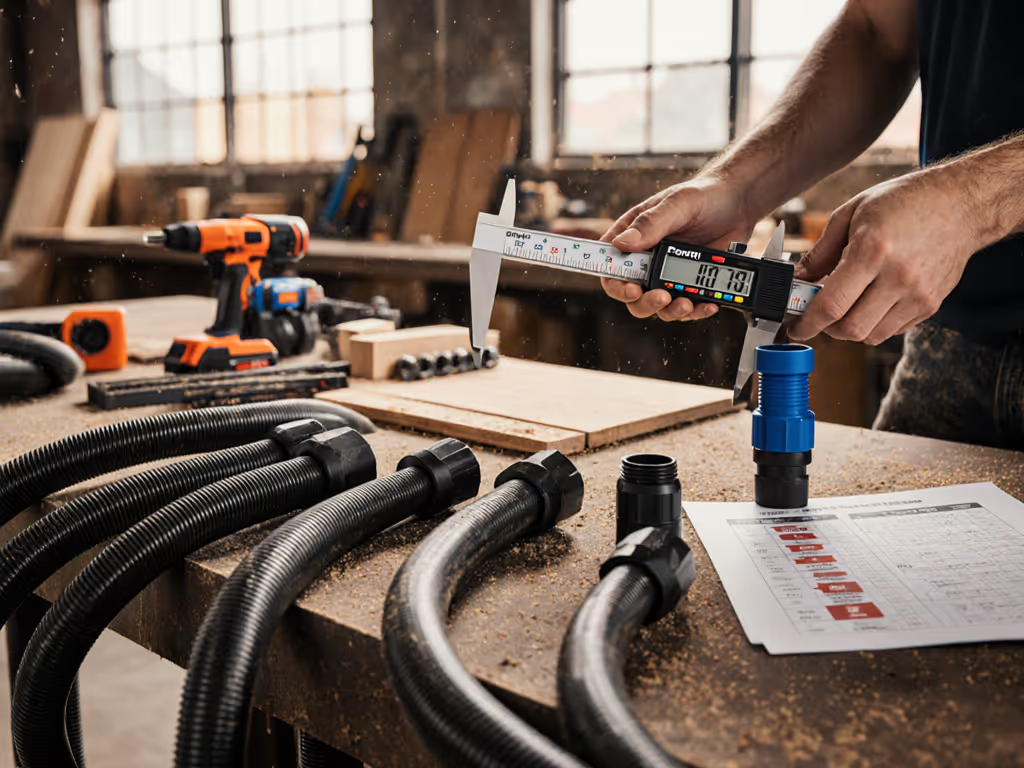
The Hidden Cost of Wrong-Sized Connections
A tool port matching system sounds technical, but it's really about one thing: does your hose actually fit your sander, your saws, your tools? On job sites across renovation and remediation work, I watch contractors waste time jury-rigging adapters, fighting loose connections, and losing suction mid-task because nobody took five minutes to check port sizes before showing up. The result is dust clouds, filter clogs, and lost credibility in front of clients.
Worse, mismatched connections leak. A gap between your 1.25-inch dust port and a hose meant for 1.5 inches doesn't just feel sloppy, it kills suction, lets fine dust escape, and turns a quick drywall sanding into a cleanup nightmare. I've seen a contractor's vac tip because an oversized hose caught a doorframe, spilling dust across freshly installed cabinets. That day taught me: vacuum hose compatibility isn't a nice-to-have. It's the difference between a professional setup and an expensive embarrassment.
Why Port Sizes Matter More Than You Think
Portable power tools and shop vacuums speak different languages. Your random-orbit sander might have a 27 mm (roughly 1-1/8 inch) dust collection port (that's a Festool standard). Your miter saw could be 2.5 inches. Your old DeWalt planer might be somewhere in between. Add a shop vac with a 2.25-inch inlet, and you've suddenly got at least three different diameters in the same job.
Without the right adapter, you'll either force a hose that's too loose (causing air leaks and suction loss) or find that nothing connects at all. Contractors often respond by wrapping tape around connections or using old threaded couplers that spin off mid-job. Neither is a fix.
Universal adapter sizing charts exist precisely because no two setups are identical. The key is knowing your starting point: measure or verify the actual internal diameter (ID) of your tool's dust port and your vac's inlet before you buy a single meter of hose.
The Port Standardization Landscape
There's no single industry standard, but a few sizes dominate: If you're mixing brands and parts, review our accessories compatibility guide to avoid fit surprises across OEM and generic adapters.
- Festool and Fein tools: 27 mm and 35 mm ribbed hose (metric anti-static), increasingly common in upscale finishing work
- Bosch, DeWalt, Makita, and Porter-Cable: Often 1.25 inches (32 mm) or 2.5 inches (63 mm), depending on tool class
- Shop vacuums: 2.25 inches (57 mm) nominal inlet, though some brands sit at 2.5 inches
- Older Craftsman and Ridgid tools: 1.5 inches, mixed threads
- Central vacuum systems and Nutone inlets: Entirely different ecosystems, with their own hose standards
The frustration builds when a contractor owns tools from three brands. Suddenly, you need three adapters to connect one tool to one vac. Set it up right, then forget it, but first you have to get it right.
Building Your Compatibility Matrix
Before you assemble a power tool vacuum connections kit, gather the following:
- Measure each tool's dust port - use calipers or a measuring tape inside the port. Write it down (e.g., "Bosch sander = 1.25 ID").
- Check your vac's inlet specs - most shop vac manuals list this; if not, measure the threaded opening.
- List the hose diameter you want - 1.5 inches is the sweet spot for most handheld tools (good suction, manageable weight), but 1.25 inch works for light sanding, and 2.5 inch is best for central dust collection. Use our hose performance guide to match length and diameter without sacrificing airflow.
- Identify quick-connect or threaded adapters - quick-change systems (like molded 3/4, 1, 1.25, and 1.5 inch ID fittings) let you swap tools without unscrewing hose fittings, saving minutes and reducing kinks.
Once you've captured those numbers, your tool port matching system becomes obvious: you need adapters to bridge the gaps, and the fewest adapters possible.
Practical Setup Examples
Mixed-brand demo crew (drywall sanding, concrete grinder, miter saw cuts):
- Vac: Shop-Vac with 2.25-inch inlet
- Hose: 10-foot 1.5-inch PVC or spring hose (kink-resistant)
- Adapters: One 2.25-to-1.5-inch threaded cuff for the vac; one quick-change connector block with 1.25, 1.5, and 2.5-inch interchangeable fittings for tools
- Result: Swap between tools without disconnecting the main hose. Shorter hose runs per tool = less suction loss. For a quick refresher on specs that impact suction, see CFM vs capacity explained.
Festool-centric fine finishing (cabinet sanding, edge routing):
- Vac: Festool CT MIDI or larger
- Hose: Two lengths of 35 mm ribbed anti-static hose (one 4-foot, one 10-foot)
- Adapters: Festool-native ports on most tools; one 27 mm to Bosch SDS adapter if cross-brand mixing is needed
- Result: Compact, sealed system; minimal dust escape; built-in static control.
Vehicle-based mobile detailing:
- Vac: Compact wet/dry unit mounted in van
- Hose: 25-foot or 35-foot central vacuum-style hose with 360-degree swivel handle
- Adapters: Direct connection to van's outlet; quick-change nozzles for crevice and upholstery work
- Result: Plug-and-go; no adapter chains; less downtime between calls.
Vacuum-to-Tool Airflow Optimization
Wrong port sizes don't just annoy, they kill suction. A loose connection is an air leak. A hose ID that's too small for the flow rate creates backpressure and filter clogging. Here's the math: If you want the physics behind these drops, read how shop vac suction works.
- Long hoses (over 20 feet) demand larger diameter: 1.5-inch hose minimum; 2.5-inch preferred if your vac can deliver the CFM.
- Small ports (under 1 inch ID) should stay on short runs: 4-6 feet max, or suction at the tool drops 40 percent or more.
- Quick-change fittings must have adequate ID: A 3/4-inch quick connector adds restriction; a 1.5-inch fitting does not.
If your vac is rated 130 CFM (a common spec), a 1.5-inch hose over 25 feet may deliver only 80 CFM at the tool. Add a clogged filter or a 1.25-inch port adapter, and you're down to 50 CFM. That's not enough for a floor sander. Measure, calculate, and over-size slightly, and you'll recover that investment in time and cleanliness.
The On-Site Reality Check
You've bought the adapters. The hose is on the truck. You arrive at a dusty basement or a freshly framed room. Pre-flight checks take two minutes:
- Lay out the hose - avoid kinks and sharp bends that kill suction. Choosing the right hose material helps here—compare rubber vs plastic hoses for flexibility and durability on-site.
- Hand-thread adapters onto ports - snug but not forced. If it takes a wrench, the fit is wrong.
- Connect the vac to the tool hose, then to the vac inlet - test suction at the tool before you turn on power tools.
- Set up a cord path away from foot traffic (a tipped vac is a disaster).
- Secure the hose to the vac with a strap or clip, which prevents whipping if a tool pulls free.
That's how you avoid the slow-motion chaos of a setup that fails twenty minutes into the job.
Your Next Step: Create Your Compatibility Checklist
Don't guess. Pull out your tools - sanders, saws, grinders, extractors - right now. Write down each one's dust port ID, your vac inlet, and the hose diameter you want. Cross-reference a universal adapter sizing chart (look for ones that list ID in both inches and millimeters, plus real part numbers). Order the adapters and a test length of hose. Try it in your shop before a job.
Then, take a photo or create a label noting your final setup: tool ports → adapters → hose diameter → vac inlet. Post it on your vac or in your truck. New crew members see it instantly. No confusion. No wasted trips. A vac that stays upright keeps your reputation upright.
Smooth workflow beats specs. But right-sized connections enable smooth workflow. Set it up right, then forget it.
Related Articles