Advanced Materials Vacuums: Carbon Fiber Dust Collection Compared
By Aisha El-Sayed • 25th May

Advanced composites and nano-enabled products changed the game: the advanced materials vacuum you choose now matters as much as the grinder or sander you hook to it, especially for carbon fiber dust collection and other fine, conductive powders. For a deeper dive into advanced composite dust risks, see our carbon fiber dust collection guide.
If you've ever watched a black haze of composite dust hang in the air (or felt static snaps up your arm while vacuuming), it's proof the old "shop vac and hope" approach doesn't cut it anymore. Containment first; cleanup is the insurance your lungs deserve.

FAQ: What Makes Carbon Fiber and Advanced Materials Dust Different?
Why is carbon fiber dust such a big deal compared to wood or drywall dust?
Carbon fiber and other advanced materials dusts are different on three fronts:
- Particle size and shape
- Carbon fiber and many composite dusts break into fine, sharp, and often respirable particles that can stay airborne longer than typical construction dust.
- Add nano-fillers (carbon nanotubes, metal oxides, graphene) and you are now in nanomaterial vacuuming territory, where some particles are too small for standard filters to reliably capture.
- Electrical behavior (conductive dust handling)
- Carbon fiber, some metal-loaded polymers, and 3D printing powders can be electrically conductive, meaning they can bridge circuit boards, damage electronics, or create ESD (electrostatic discharge) risks if not controlled.
- A regular plastic hose can build charge and spark; pair that with flammable or solvent-laden atmospheres and you've got a serious hazard.[5][8]
- Contamination risk
- In shops serving aerospace, medical, or electronics clients, a single batch of cross-contaminated dust (carbon fiber in an aluminum-only process, for example) can ruin parts and cause expensive rework.
- In labs and cleanrooms, advanced materials dust is treated closer to a hazardous material than simple "dirt," driving the need for specialty research lab vacuum and cleanroom vacuum performance standards.[5][8]
If it isn't captured, it gets inhaled.
Why can't I just use a standard wet/dry shop vac for carbon fiber dust?
You can move the dust with a standard vac, but you usually fail in three ways:
- Filtration: Standard cartridge filters and bags are not rated for very fine or nano-scale dust; they clog quickly and leak through their media or seals.[5][7]
- Sealing and joints: Consumer/shop vacuums often have unsealed seams, loose latches, or non-gasketed lids that leak when under fine-dust load, creating a halo of dust around the machine.[7]
- Static and conductivity: Non-anti-static hoses plus conductive dust equals shocks and potential damage to electronics and sensitive instruments.[5]
Industrial vacuums built for construction, remediation, and hazardous materials exist for exactly these "fine, persistent, high-risk" dust types, including composite and 3D-printing powders.[4][5][7][8]
Pass/Fail quick check
- PASS: Vac has documented fine-dust or HEPA filtration, gasketed lid, and anti-static or conductive hose, and is rated for hazardous or specialty dust.[4][5][7][8]
- FAIL: No published filtration rating, generic plastic hose, no mention of hazardous or conductive dust.
FAQ: What Is an "Advanced Materials Vacuum" in Practice?
How do you define an advanced materials vacuum?
In my world, an advanced materials vacuum is any vacuum system designed and documented for fine, potentially hazardous, and/or conductive dusts such as:
- Carbon fiber and fiberglass dust
- Composite sanding and cutting dust (epoxies, resins, fillers)
- Metal-filled polymers and carbon-loaded plastics
- 3D printing powders and support media (including metal and polymer powders)[8]
- Nanomaterials and engineered particles
These systems usually differ from generic vacs by having:
- High-efficiency filtration: Often HEPA or multi-stage (bag + fine filter + optional HEPA) with published efficiencies, sometimes geared to hazardous material standards.[5][7]
- Sealed construction: Gasketed lids, tight clamps, and smooth internal surfaces to limit leaks and build-up.[4][7]
- Static control: Anti-static or conductive hoses and grounded components to manage ESD risks.[5][8]
- Documentation: Clear statements about which dust types they are intended to handle (e.g., "for combustible dust," "for fine powders," or "for 3D printing").[4][5][8]
Industrial and hazardous-material vacuums sold for construction, remediation, and additive manufacturing are common examples of this category.[4][5][7][8]
How is carbon fiber dust collection different from general composite dust collection?
Carbon fiber dust is just one slice of advanced materials, but it pushes vacuums harder than many others:
- Higher conductivity: Carbon fiber shards conduct electricity better than many glass fibers, so static control is more critical.
- Abrasiveness: The fibers and fillers can abrade hoses and filters faster, shortening service life.
- Visibility and client perception: Black dust streaks on white paint or interiors look worse than light-colored dust; clients notice.
For carbon fiber dust collection, I over-spec toward:
- Anti-static or conductive hoses and tools
- HEPA or high-efficiency fine-dust filters
- Pre-separators if you're doing heavy grinding, to protect the main filter
FAQ: What Specs Actually Matter for Advanced Materials Vacuums?
CFM, water lift, HEPA... what matters for carbon fiber and nano dust?
Think in three buckets: capture, contain, control.
- Capture: CFM and water lift
- CFM (airflow) pulls dust into the hood or nozzle. For sanding and grinding composites, you typically want medium-to-high CFM with a right-sized hose (often 27-36 mm or 1-1/4" to 1-1/2").
- Water lift (sealed suction) matters when pulling dust through long hoses or tight crevices and when using pre-separators. Higher water lift keeps capture effective at the tool.
- Contain: filtration and sealing
- Look for fine-dust or HEPA filtration designed for hazardous or sensitive dusts; many industrial vacuums are explicitly sold for this class of work.[4][5][7][8]
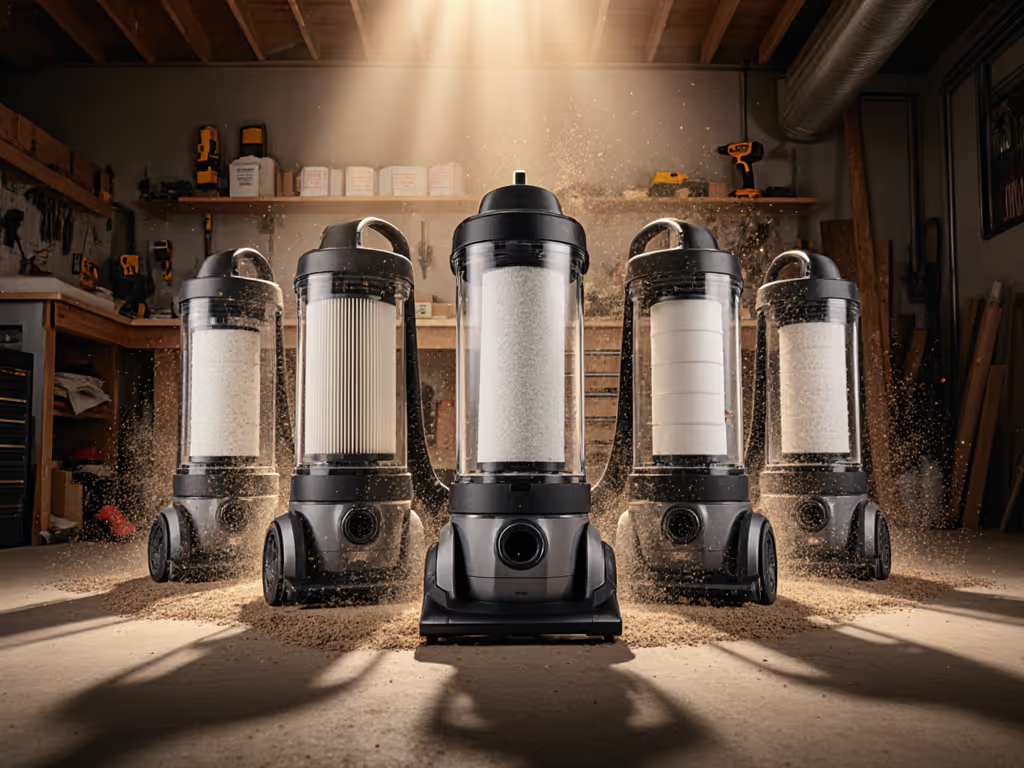
- Multi-stage setups (bag + filter + optional HEPA cartridge) keep suction consistent and reduce filter clogging.
- A good vacuum is, by definition, a low-pressure environment with very little matter escaping; leaks at seams destroy that benefit.[1]
- Control: static, conductivity, and emissions
- Anti-static or conductive hoses reduce shocks and help safely ground conductive dusts.[5][8]
- Some units are specifically marketed for explosive or combustible dusts; their design language overlaps heavily with what you want for conductive composite dust.[5][8]
Do I always need HEPA for composite and nanomaterial vacuuming?
Not always, but it is often the safest default when:
- You are sanding or cutting carbon fiber, fiberglass, or composite laminates indoors.
- You handle nanomaterials or powders where particle size is unknown or very small.
- You work in labs, healthcare, or clients' occupied spaces where air cleanliness expectations are higher.[5][8]
Situations where non-HEPA may be acceptable:
- Coarse debris cleanup in open, well-ventilated shops, after primary fine-dust capture is handled at the source.
- Low-risk outdoor work far from occupants or air intakes.
I never claim compliance without documentation; check your local regulations, project specs, and manufacturer guidance for definitive requirements. If you need verified performance, compare true HEPA-certified vacuums tested for sub-micron capture.
FAQ: Static, Conductive Dust, and ESD Safety
What's special about conductive dust handling?
Conductive dust (like carbon fiber shards or metal powders) can:
- Bridge terminals on circuit boards and electronics.
- Create unintended conductive paths in equipment.
- Contribute to ESD events when combined with charge build-up in plastic hoses.[5][8] For tool and hose selection that prevents static damage, see our ESD-safe shop vac guide.
For conductive dust handling, advanced materials vacuums typically provide:
- Conductive or static-dissipative hoses to bleed charge away safely.[5][8]
- Grounding points and bonding straps to connect the vac, tools, and sometimes the workpiece.
- Sometimes intrinsically safe or explosion-proof designs when flammable or combustible dusts are involved.[5]
Pass/Fail quick check for conductive dust
- PASS: Hose and attachments are marked anti-static or conductive, and the vac manual addresses conductive or hazardous dust.
- FAIL: Standard glossy plastic hose, no ground point, no mention of static or conductive dust.
How does this change for a research lab vacuum or cleanroom vacuum performance?
In labs and cleanrooms, the bar is higher:
- Cleanroom vacuum performance focuses on ultra-low particle emissions and easy decontamination. Housings are often smooth and chemical-resistant to tolerate wipe-down and disinfection.[5][8]
- Research lab vacuum setups may include multiple filters in series (HEPA + ULPA, or HEPA + activated carbon) and strict protocols for bag change, labeling, and disposal.[5]
Industrial and hazardous material vacuums are explicitly marketed for these scenarios, especially around nano powders and additive manufacturing dusts.[5][8]

FAQ: Scenario-Based Setups and Checklists
What setup do I need for a small composite or carbon fiber fab shop?
Typical tasks:
- Cutting and grinding carbon fiber or fiberglass laminates
- Sanding composite body panels
- Occasional mold repair and epoxy work
Recommended advanced materials vacuum setup:
- Vacuum: Industrial fine-dust or hazardous-material vac with optional HEPA stage.[4][5][7]
- Filtration: Bag + fine filter, HEPA if indoors or around other trades.
- Hose: Anti-static or conductive, matched to your tools (27-36 mm range for most sanders/grinders).
- Tool interface: Purpose-built shrouds or hoods for saws, grinders, and sanders.
- Extras: Cyclone dust separators or pre-separator for heavy grinding to extend filter life.
Pre-flight checklist (fab shop)
- Filter and bag installed, seated, and latched.
- All latches fully closed; gasket surfaces clean.
- Hose continuity checked (no deep cuts, secure cuffs).
- Tool ports fit snugly without long adapter chains.
- Grounding/anti-static features connected if supplied.
If any of these fail, fix them before cutting. That's spoken from experience: I have seen a crew cited after assuming "any vac" was good enough while a black dust cloud rolled across a site.
What about mobile work: auto body, detailing, or on-site composite repair?
You're often in tight, occupied spaces (dealerships, hangars, or clients' garages), so you need:
- Compact, stable vac with real casters and a low tip risk.
- Noise control: Quieter operation and, if possible, mufflers, so work can continue around you.[10]
- Sealed bags and HEPA filters when sanding inside vehicles or near finished interiors to avoid blow-back into the cabin.[5][7]
Checklist before rolling into a client's space:
- Vac exterior wiped down; no dust clinging to the housing.
- Bag at <75% capacity to maintain airflow.
- Hose and power cord neatly managed; no trip hazards.
- Fine-dust or HEPA filter inspected; no visible damage.
What should a facilities or janitorial manager consider for nano-enabled materials?
Schools, light industrial, and healthcare sites are increasingly using nano-enabled coatings, specialty paints, and advanced materials. For nanomaterial vacuuming on these sites:
- Choose a vac with documented HEPA or higher filtration, marketed for hazardous or fine dust.[5][8]
- Implement color-coded hoses, wands, and tools for nano/advanced materials vs general janitorial use to avoid cross-contamination.
- Train teams to bag and label advanced-material waste separately, following your EHS guidance.
Containment first; cleanup is the insurance your lungs deserve.
FAQ: Filter Changes, Decon, and Cross-Contamination
How often should filters and bags be changed with advanced materials dust?
There is no one-size rule, but these guidelines keep uptime and safety aligned:
- Bag: Change when 50–75% full for fine composite dust to prevent CFM loss.
- Pre-filter/fine filter: Inspect daily for heavy-use operations; replace at the first signs of persistent suction loss or physical damage.
- HEPA: Follow manufacturer schedule or change when differential pressure or airflow indicates restriction; do not bang or blow out HEPA filters, as this can damage the media.[5][7]
Keep a simple SKU roadmap: one labeled spot for each replacement bag, fine filter, and HEPA element so crews can grab the right part under pressure.
How do I avoid cross-contamination when switching between tasks?
For shops juggling clean tasks and advanced materials:
- Dedicate one vacuum (or at least one fully dedicated hose and accessory set) to carbon fiber and nanomaterial work.
- Use sealed bags and close them inside the vac before removal.
- Wipe exterior surfaces with appropriate cleaners, especially when moving between clean and dirty zones.[5]
- Store "advanced materials" vacs and accessories in a labeled cabinet or cart. When disposing of used filters or captured debris, follow our vacuum filter disposal guide for OSHA/EPA-compliant steps.
Cross-contamination is a business risk as much as a health risk; clients notice when black composite dust shows up where it doesn't belong.
FAQ: How Do I Choose Between Models and Brands?
What are the must-have features for an advanced materials vacuum?
When comparing options, map them against this short list:
- Documented fine-dust or HEPA filtration, ideally with hazardous or advanced-material references in the manual.[4][5][7][8]
- Sealed construction with gasketed lids and strong latches.
- Anti-static or conductive hose system with grounding provisions.[5][8]
- Adequate CFM and water lift for your hose length and tool ports.
- Tool compatibility: Hoses and adapters that fit your actual sanders, grinders, and saws without long, leaky chains.
- Serviceability: Ready access to replacement bags and filters; clear part numbers.
If a unit omits static control and fine-dust documentation, it's not my first choice for carbon fiber dust collection.
How can I future-proof my setup as materials evolve?
Advanced materials will keep changing, but your control philosophy doesn't have to. To stay ahead:
- Standardize around a sealed, high-filtration, anti-static platform now.
- Maintain a written pre-flight checklist for advanced materials tasks; update it as new materials appear.
- Ask manufacturers directly whether their system has been used for carbon fiber, nano powders, or 3D printing dusts; note their answers with the equipment records.[4][5][8]
Where you go from here:
- Walk your current shop or job setup with this article in hand; mark each vac as OK for advanced materials or general use only.
- Build a simple labeled kit (vac, hose, shroud, filters, and bags) for composite and nanomaterial work so crews never have to guess.
- When in doubt, over-spec toward sealed systems and verified filtration capacity. The cost of a better vacuum is minor next to fines, rework, or a client who loses trust in your controls.
Remember: in advanced materials work, the vacuum is not an accessory. It is part of the process. If it isn't captured, it gets inhaled.
Related Articles