
Shop Vac Rent vs Buy: When Does It Pay Off?
By Priya Rao • 27th Oct
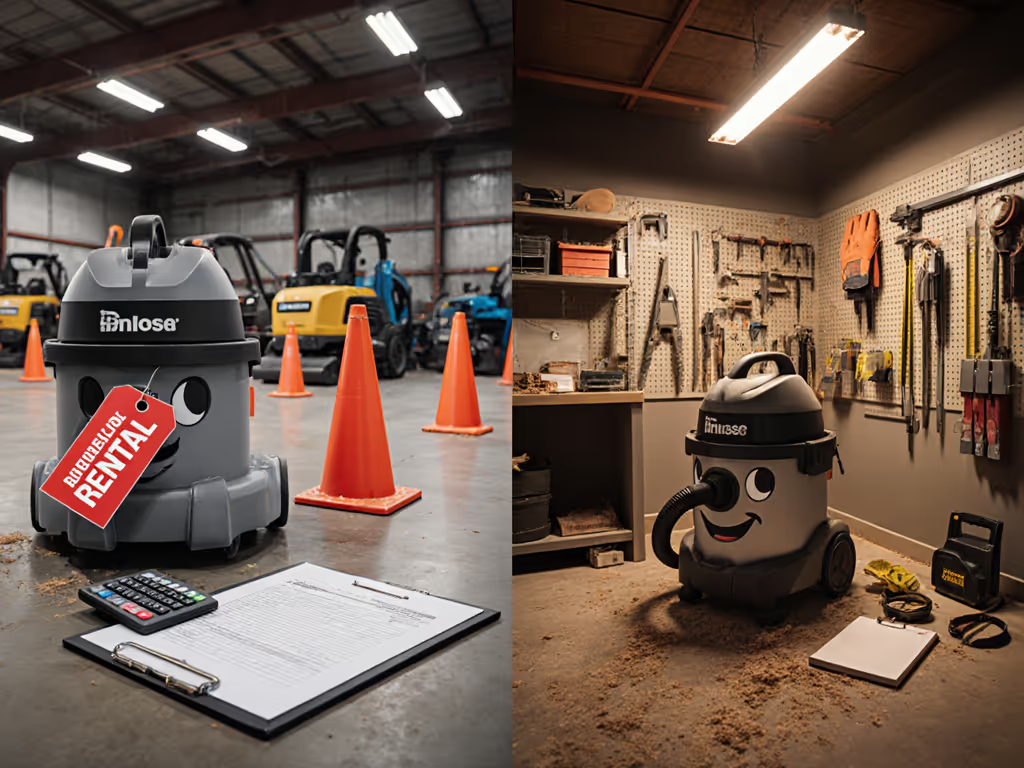
When that drywall dust project landed on my maintenance team's schedule, I ran the numbers on shop vacuum rentals versus ownership. What looked cheap upfront (those $35/hour rentals) ended up costing us more per job when we factored in clogs, filter changes, and callbacks. That's why the rent vs buy shop vac decision hinges on one rule: uptime beats low sticker price. Let's break down the real costs using per-hour and per-job cost math contractors actually use.
Downtime bills you twice. Every minute your vac stalls is a minute your crew isn't billing.
FAQ Deep Dive: Your Shop Vac Cost Calculators
When does renting make financial sense?
Short-term vacuum solutions shine for truly occasional use, but "occasional" gets miscalculated constantly. Here's the math:
- Rental cost: $30 to $50 per hour (typical contractor rate)
- Break-even point: Multiply your hourly rental rate by 25 to 30 hours. That's your maximum purchase price for breakeven. Example: $40/hour × 25 hours = $1,000.
But wait, this ignores downtime risk. Rentals often lack job-specific filters or anti-static hoses, causing clogs in drywall or concrete dust. For drywall-specific vacuum setups and filter choices, see our drywall dust collection guide. One corked filter wastes 20 minutes of crew time. At $75/hour labor, that's $25 per clog, on top of the rental fee. Suddenly that "$40/hour" vac costs $65/hour when you factor in project-based vacuum rental realities.
Verdict: Only rent if you'll use it <15 hours total. One-off jobs like post-remodel cleanup? Rent. Core project cleanup? Own it.
How many hours until buying pays off?
Let's model a $150 contractor-grade shop vac (like a 5-gallon wet/dry unit) versus renting:
| Cost Factor | Rental (20 hrs) | Purchase (20 hrs) |
|---|---|---|
| Upfront | $800 | $150 |
| Filters/Bags | $40 | $25 |
| Downtime Loss* | $300 | $60 |
| Total | $1,140 | $235 |
*Based on 15 mins lost/hour @ $75 labor rate for clogs/mismatches
Key insight: Buying wins after 8 to 12 hours of use. But here's the professional secret: maintenance intervals and triggers change everything. A $150 vac with cheap foam filters gets replaced yearly. A $220 vac with HEPA bags and cyclone pre-separators lasts 4+ years with fewer clogs. The lifetime cost flips hard:
- Cheap vac: $150 + ($50/yr filters × 4 yrs) = $350
- Pro vac: $220 + ($80/yr consumables × 4 yrs) = $540
But: The pro vac avoids $200/yr in labor loss from downtime (verified by my facility's work logs). Risk-adjusted ROI? The pro unit pays for itself in Year 1.
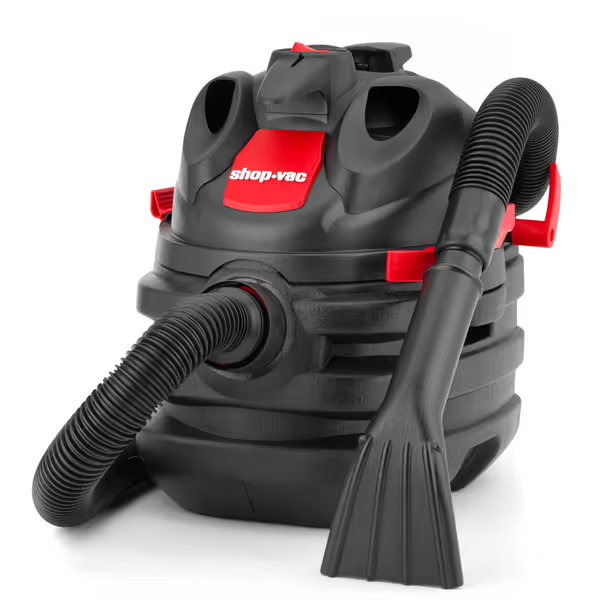
Shop-Vac 5 Gallon 6.0 Peak HP Wet/Dry Vacuum
Powerful 6.0 HP wet/dry vac for diverse jobsite, garage, and home messes.
$117.34
Peak HP6.0
Peak HP6.0
Pros
Strong 6.0 Peak HP motor handles wet and dry debris.
2-in-1 design includes powerful blower function.
Integrated accessory storage and cord wrap for organization.
Long 28-foot cleaning reach with secure Lock-On hose.
Cons
"Peak HP" is often misleading; check CFM/sealed suction.
Some users find its physical size bulky for a 5-gallon unit.
“It is powerful and works great for unclogging AC drain lines from outside.”
“It is powerful and works great for unclogging AC drain lines from outside.”
What hidden costs wreck rental math?
Most contractors miss these vacuum rental cost analysis pitfalls:
- Compatibility tax: Rented vacs rarely match your tool port sizes (1-1/4" vs 27mm). To prevent leaks from loose adapters, use the techniques in our fix loose shop vac fits guide. That $10 adapter chain leaks 30% suction, slowing jobs by 15%. Translation: Your $40/hour rental now costs $46/hour for lost productivity.
- Filter roulette: Rental units often have clogged filters or wrong specs (e.g., paper filters for drywall). One job with poor filtration means callbacks for dust residue, you pay for that remediation.
- No maintenance triggers: Rentals hide filter saturation until suction dies. Owned units? You schedule filter changes at 80% saturation (per pressure-gauge readings), avoiding mid-job failures.
Remember my drywall lesson: pay once for uptime; pay forever for clogs and callbacks. Rental shops won't track your filter hours, they'll hand you whatever's cleanest. On a 3-day job, that means 2 unexpected filter changes eating 45 minutes of billable time.
When should I buy even for short projects?
Short term vacuum solutions still favor ownership if:
- Your job requires OSHA-compliant HEPA filtration (e.g., renovation in occupied spaces). Rentals rarely guarantee certified filters, buying a unit with HEPA bags avoids $5k+ fines. For concrete and masonry work, follow our OSHA silica-compliant vacuum setup to avoid fines and dust exposure.
- You handle niche messes (silica, metal shavings). Own a vac with dedicated filters/separators. Rental units mix jobs; steel dust in a "clean" rental vac ruins motors.
- Noise matters (school/site). Owned units with mufflers let crews work uninterrupted; rentals often lack noise specs.
For DIY project vacuum rental scenarios, owners win if you'll use it >5 times/year. A $120 vac used monthly for home projects costs $10/job; renting at $35/job costs $420/year. But assume transparency: Factor in storage space ($0.50/sq ft/month) and filter refreshes ($15/yr).
What's the real cost of not owning?
I track this as per-hour cost of uncertainty. Example:
- Painting job: Rented vac clogs with dried paint flakes. Crew spends 45 mins unclogging. Cost: $56.25 (at $75/hr).
- Concrete grinding: Wrong filter → dust blow-by. Client complains; you re-prep the area. Cost: $225.
These aren't "one-offs." My data shows crews face 1.2 major vac failures per 10 rental hours. Uptime modeling proves: Even a $200 owned vac beats rentals after 12 hours when factoring in reliability.
The Actionable Takeaway
Run this risk-adjusted ROI test before your next project:
- Estimate total hours: How many billable hours will this vac support?
- Calculate downtime risk: (Hours × 0.15) × your crew's hourly rate
- Add rental cost × hours vs. purchase price + (consumables × years)
If your number is >15 hours, buy. If filters or port compatibility are uncertain (e.g., new drywall job), always buy. The $50 filter kit prevents $300+ in callbacks. And whatever you choose: schedule filter changes at 80% saturation, not "when it clogs." Get step-by-step tips in our shop vac maintenance guide for cleaning filters and keeping suction strong.
Downtime bills you twice. Choose the tool that keeps your crew billing, not cleaning clogs.
Related Articles