
Commercial Fine Dust Vacuums: Corded vs Cordless
By Hana Kobayashi • 11th Mar
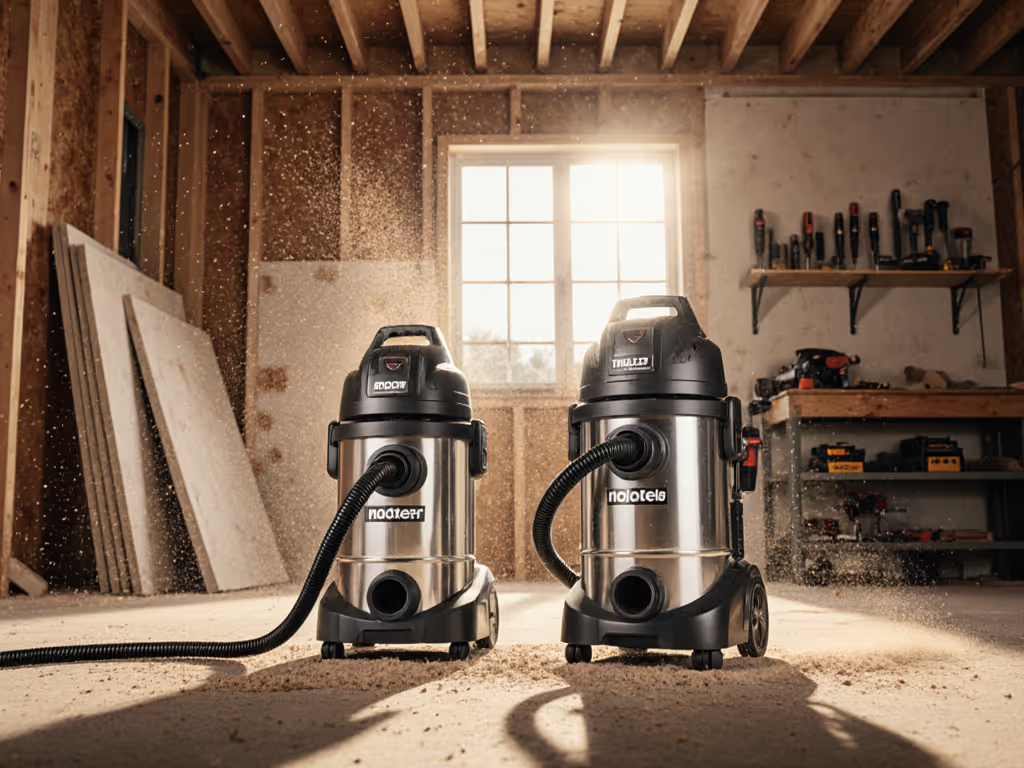
When you're choosing between a commercial cordless vacuum and a corded model for fine dust collection, you're making a decision that affects every hour on site. This isn't just about suction specs; it's about whether you'll spend the day chasing hose tangles and power cords, or moving freely through tight spaces. Both have earned their place in professional work, but only one fits your workflow, your tools, and your reputation for a clean job.
I've watched crews waste half a morning troubleshooting vac setups, and I've seen a single mismatched filter tank bring a job to a halt. The difference between the two comes down to runtime, sealing, portability, and how they integrate with your crew's rhythm. Let me break down what matters in the field.
1. Understanding Sealed Suction vs. Peak Horsepower
Marketing loves to throw "peak HP" at you, but that number is almost useless on a jobsite. What you actually need is sealed suction (measured in water lift, inches of water column, or CFM, cubic feet per minute, under load). A test of cordless wet/dry models found the EGO averaging 126 CFM, while the Ryobi 18V delivered 107 CFM and Milwaukee Nexus reached 104 CFM. Those real numbers tell you what happens when your hose is fully extended and your filter is working hard.
Fine dust collection, whether drywall, concrete, or sanding dust, demands consistent airflow that doesn't collapse under filter loading. Corded vacuums hold their suction steady because they draw continuous line power. Cordless units throttle as battery charge drops, which can mean 15 minutes of full power, then a slow bleed out over the remaining time. Know what you're getting before you commit.
2. HEPA Filtration: The Sealed System That Matters
HEPA filtration isn't just a marketing checkbox; it's the difference between capturing 99.97% of fine particles or watching dust settle on fresh paint hours later. Here's the critical part: HEPA only works if the whole system is sealed. A dusty canister, a loose lid, or a hose that pops off under suction defeats the filter entirely.
Corded commercial vacuums like the ProTeam ProGen 15 include sealed HEPA systems that maintain negative pressure throughout the tank. Many cordless models now match this with fully sealed filtration that captures fine particles the same way. But check the specification carefully: "HEPA-type" is not the same as certified HEPA. And confirm the hose connector won't leak; I've seen crews leave a filter unsealed because the dust cap was "good enough." It wasn't.
For silica, mold, or any health-critical dust, verify your vac meets OSHA compliance standards. For concrete and masonry work, see our OSHA-compliant silica dust vacuum guide. A dust extractor, unlike a shop vac, is built with automatic filter cleaning, high suction, and sealed airtight systems specifically to handle harmful fine dust and prevent it from escaping into your lungs.
3. Runtime Reality: Cordless Doesn't Mean All-Day
Cordless vacuums promise freedom, and they deliver it (for a set window). The Dyson Car+Boat cordless portable provides up to 50 minutes per charge, which sounds reasonable until you're mid-job and the battery hits 20%.
Here's what I've learned on real sites: a cordless unit is perfect for quick, targeted cleanups and spaces where a cord is a tripping hazard or a workflow killer. Use it to clean out cabinets mid-install, hit a sanding corner before the next coat dries, or tidy up before a client walk-through. But for a full day of demo cleanup, drywall sanding, or remediation work, you'll spend more time swapping batteries than actually pulling dust.
Corded vacuums deliver consistent power for 8+ hours without a charge cycle. For a head-to-head breakdown, see our corded vs cordless runtime and power test. No batteries to manage, no mid-morning scramble to find a charger. Dust collector runtime matters most when you're committing 4+ hours to a single task, then corded is your answer.
If you're working with batteries, invest in a two-pack so one charges while you work. Better yet, plan your cordless work in 40-minute blocks with 15-minute breaks built in.
4. Noise: When You Work Around People
Woodshop noise levels and occupied-space concerns are real. A commercial backpack vacuum with proper engineering runs around 67 decibels, which is manageable but still noticeable. Compare options in our low-noise shop vacuums guide if you work in occupied spaces. Some cordless models engineer vibration dampening to reduce noise without sacrificing suction, the Dyson cordless design, for instance, absorbs vibration and reduces noise through acoustic engineering.
Corded uprights and canister models vary widely. If you're working in a school, healthcare facility, or renovation inside an occupied home, noise can make or break your contract. A quiet corded unit often beats a cordless one simply because the customer doesn't complain to your supervisor.
Test before you buy. Bring a decibel meter to a demo or watch third-party noise tests. What feels quiet in an empty showroom can be irritating in a small bedroom for 6 hours straight.
5. Stability and Form Factor: A Vac That Stays Upright
I once watched a tall backpack vacuum catch a power cord during a client walk-through. It tipped, puffed drywall dust across new cabinets, and became the most expensive $400 lesson I learned: a vac that stays upright keeps your reputation upright. That day I replaced the setup with a low, stable canister model, shortened the hose to 25 feet, added a fleece bag, and strapped the tools. The next tour was quiet, clean, and nobody noticed the vac at all.
Corded upright vacuums have a lower center of gravity and wider footprint: harder to tip, easier to position in tight spaces. Backpack models (corded or cordless) are ergonomic for your spine but create a tipping hazard in tight hallways or on ladders. Canister models stay put and won't roll away if you leave them unattended.
Cordless portables are compact and lightweight, which is great for mobility but risky if you're working one-handed while holding drywall or a sander. A 10-pound vac feels light at minute 30, but at minute 90, fatigue leads to drops.
Choose based on your job profile, not just the feature list. Set it up right, then forget it. Don't spend the day micro-managing your equipment.
6. Hose Diameter and Adapter Compatibility
Fine dust doesn't forgive a loose connection. If your hose diameter doesn't match your tool port, you'll lose suction before the air even reaches the vac. Corded commercial models often come with multiple hose sizes (1.25", 1.875", 2.5") and interchangeable nozzles. Cordless units, especially portable models, sometimes default to smaller diameter hoses that look convenient but create bottlenecks.
Longer hose runs also bleed suction. A 50-foot run through a multi-story building will drop your effective CFM by 20-40% compared to a 15-foot run. Corded models let you place the vac centrally and still reach every room. Cordless units excel at point-source work but force you to manage a more compact setup.
Before you choose, verify your exact tool ports and hose lengths needed. Measure twice, buy once.
7. Filter Clogging: Why Automatic Cleaning Matters
Makita dust extractors with dual 40-volt batteries feature automatic filter cleaning that maintains consistent airflow and captures 99.97% fine dust. The catch: you can't disable this function, which is actually a feature if you're doing heavy-duty fine dust work. Other models like the Hilti and Festool lines include top-access filter designs that allow quick, clean filter changes without opening the debris tank.
Corded commercial vacuums often use larger filter cartridges that clog less frequently, but they take longer to clean manually. Cordless portables use smaller filters that clog faster, especially in fine dust, and need more frequent intervention.
If you're pulling drywall, concrete, or sanding dust all day, a model with automatic filter cleaning or a pre-separator cyclone is worth the investment. To choose the right pre-separator, see our cyclone systems comparison. A clogged filter kills suction faster than a dead battery.
8. Cost of Ownership: Filters, Bags, and Downtime
A $600 corded vacuum that needs an $80 filter every 6 months and runs for 10 years costs less in total ownership than a $500 cordless that requires new batteries ($100 every 5 years) and filters every 4 months. Add in the time spent waiting for batteries to charge, and the math shifts even more toward corded.
Comparative results show that larger capacity models (8-12 gallon) and sealed HEPA systems reduce filter replacement frequency. Corded models typically offer larger tanks, which means fewer stops to empty and less frequent filter swaps.
Before committing, ask the seller for a maintenance schedule and typical filter or bag costs over 3 years. That number often surprises crews who only look at the sticker price.
9. Wet Pickup and Cross-Contamination
If your work includes water damage restoration, flood cleanup, or mold remediation, you need sealed suction and proper drainage. Some cordless models claim "wet/dry" capability but use paper filters. Use one on wet material and you've ruined the motor. Corded wet/dry vacuums include drain ports, foam sleeves, and filtration designed for moisture without failure.
Cross-contamination is also a real concern. A vac used on mold one day, then switched to your clean-air sanding the next, spreads spores if you don't decontaminate properly. Professional-grade sealed systems help, but you still need a protocol.
For water and bio-hazard work, stick with corded wet/dry models that are purpose-built and don't risk contaminating your cordless battery unit.
10. The Hybrid Approach: Corded as Anchor, Cordless as Scout
The most efficient crews I work with don't choose one; they use both. A corded canister sits centrally on the main floor, running 8 hours straight. A cordless portable handles secondary spaces, quick touchups, and mobile detailing work. The cordless never replaces the corded anchor; it extends capability without creating a dependency.
This approach requires higher initial investment but eliminates the choice anxiety. Each tool has a clear mission, and when you assign the right tool to the right job, uptime skyrockets.
Your Next Step: Audit Your Workflow
Before you buy, answer three questions: How long is your typical fine dust session? If it's under 45 minutes, cordless wins on convenience. Are you working in occupied spaces where noise matters? Then prioritize sealed, quiet models, corded or cordless. How often do you need true portability? If you're moving between job sites daily, cordless flexibility pays dividends.
Write down your most common mess (drywall, concrete, water, sanding dust), your tool ports, your hose run length, and your noise tolerance. Then match that profile to a sealed, tested system, not just a vac, but a complete kit with the right filter, bag, hose, and adapters. The $150 you spend on verification saves $1500 in wasted setups and lost time.
A vac that fits your workflow isn't a luxury; it's the difference between a crew that keeps moving and one that stops to troubleshoot. Set it up right, then forget it.
Related Articles