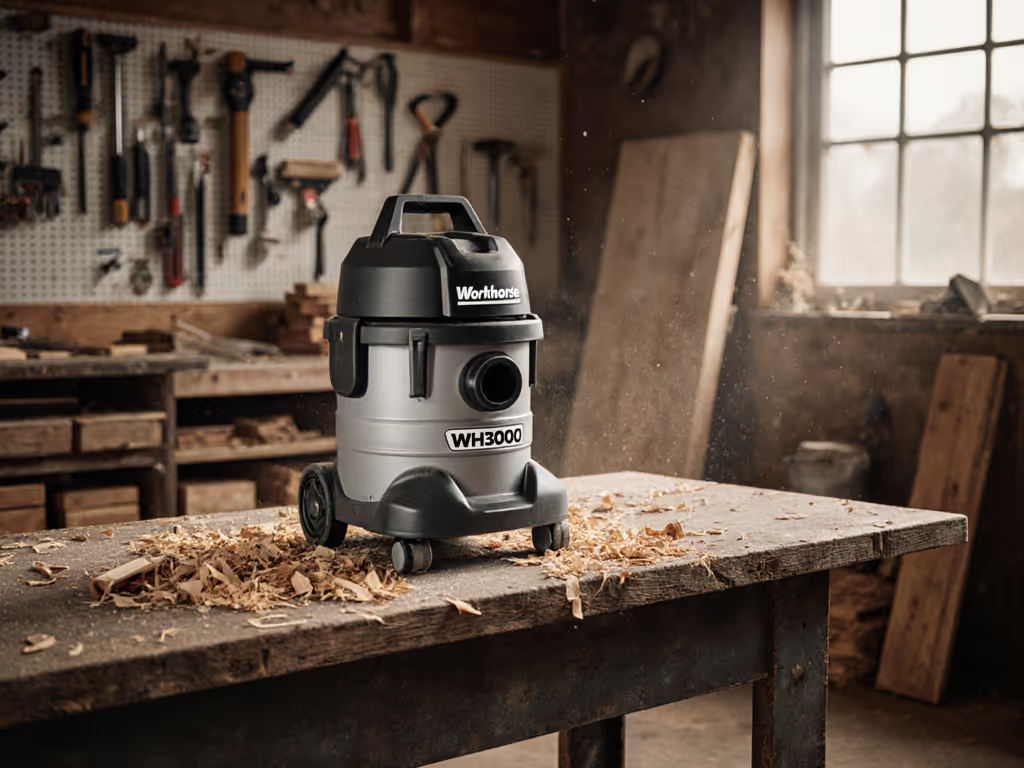
Workhorse WH3000 Review: Heavy-Duty Contractor Value
By Priya Rao • 19th Feb
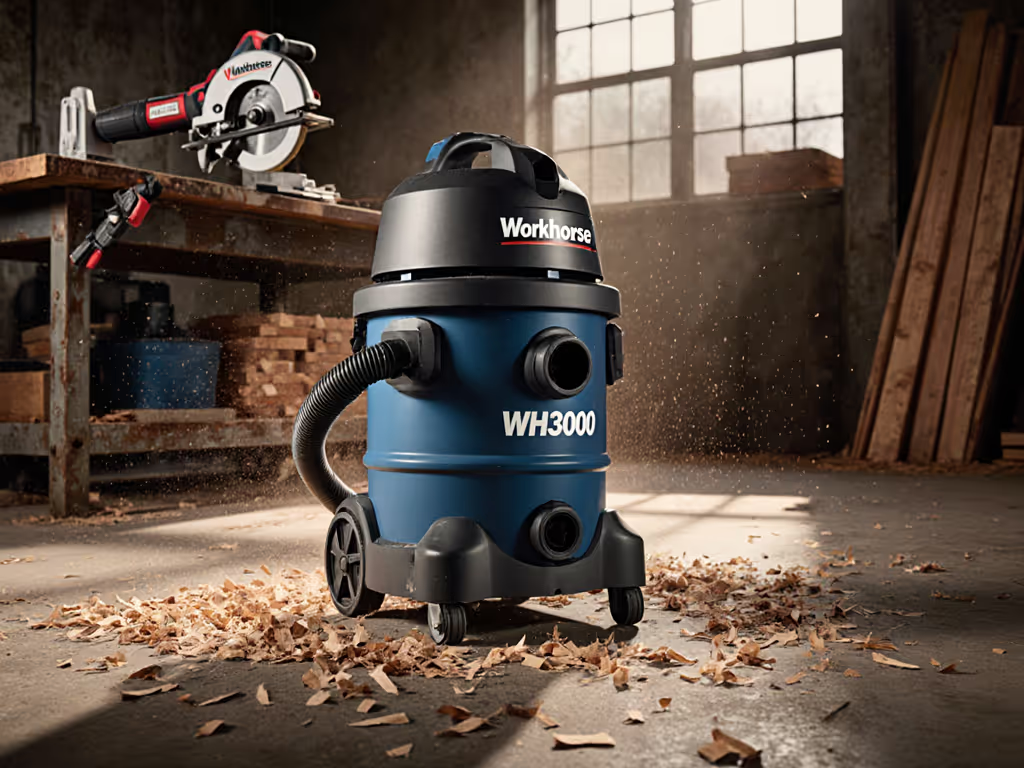
Workhorse Heavy-Duty Vacuum Review: Contractor Value and Long-Term Performance Math
When you're running a drywall crew, prepping concrete, or managing facility cleanup across multiple sites, a heavy duty vacuum isn't just a tool; it's a job-site engine. I've watched contractors choose based on sticker price alone, then lose more in downtime and filter replacements than they ever saved upfront. This review cuts through the marketing and translates Ruwac's Workhorse lineup into per-job and per-hour decisions that actually protect your margins.
Why Contractor-Grade Vacuums Matter More Than You Think
The difference between a consumer bagless vac and a durability-tested commercial unit shows up in two places: filter life and suction recovery. A year into drywall work, I tracked the real costs on our crew. The cheap bagless units clogged faster on fine dust, lost suction within weeks, and required constant filter babysitting. We switched to a sealed, manual-filter-shake design with HEPA bags and scheduled maintenance triggers. The consumables budget rose slightly per quarter, but downtime bills you twice, in labor standby and in callback dust complaints. That shift alone cut our per-job cleanup time by 30 percent. It paid for itself fast.
Key Considerations for Your Application
1. Understand CFM, Water Lift, and What They Actually Mean for Your Job
Searching specs, you'll see "300 CFM" and "6.2 inches of water lift" listed for Workhorse models. CFM (cubic feet per minute) is raw air movement; water lift is sealed suction pressure. For a deeper spec breakdown, read our CFM vs water lift guide. Neither tells you whether the vac will pull fine drywall dust from a sander's 2-inch port over a 50-foot hose.
Ruwac's Workhorse Quiet Series offers 180 CFM (WQ183/184) and 300 CFM (WQ303/304) options. The higher-CFM models suit larger crews and longer hose runs. For solo operators or small shops, 180 CFM with the multistage MaxFlo turbine design provides "more suction using less horsepower" and achieves a "15,000 hour run time with no maintenance required," according to specifications.
Assumption to verify: If you're working alone with a sander and a 25-foot hose, 180 CFM works. Add a second tool or extend to 50 feet, and you need 300 CFM.
2. Sealed Filtration and the 99% Efficiency Promise
The Workhorse Quiet Series uses Ruwac's MicroClean filter that "contains 99% of the dust down to 0.5 microns," with a "3-year filter guarantee" and a "manual filter shaker for easy cleaning and extended filter life." That 0.5-micron rating matters for drywall and silica compliance; your OSHA risk drops when fine dust stays inside the filter, not recirculating into the air. For requirements and setup examples, see our silica dust compliance guide.
Manual filter shaking is also important: it means no cartridge replacement every month and no contractor surprise costs. You clean it on site, shake dust into the bin, and keep working. At roughly $30 to $50 per replacement filter (if you had to buy new), a three-year life on one filter saves $200+ in consumables alone. That is real money on a busy crew.
Risk-adjusted ROI note: If you're in drywall or concrete dust environments, HEPA filtration is not optional, it's a liability shield. Ruwac offers optional HEPA and ULPA filtration upgrades for Workhorse models.
3. Gas-Powered or Electric? Mobility vs. Cord Management
The Workhorse gas-powered lineup (W186 and W306 models) delivers "all the performance of a rugged, high quality vacuum without the restrictions of cords and plugs." The W186 provides 180 CFM, while the W306 upgrades to "a powerful 10 Hp motor, 330 CFM and a 28 sq. ft MicroClean filter" for larger jobsites.
Gas-powered vacuums shine on remote sites, outdoor concrete work, and multi-floor jobs where cord pooling becomes a tripping hazard. The trade-off: fuel management, engine noise, and maintenance intervals.
Electric Workhorse Quiet models run continuous duty 24/7 with no moving parts in the turbine, making them ideal for stationary setups (shop, facility, or parked at a site hub). Noise is also lower, "under 70 dB" with Ruwac's "Rapid Cool Silencer," which matters in occupied spaces and residential remodels.
Maintenance intervals: Ruwac's MaxFlo turbine for electric models requires "no maintenance" over 15,000 hours. Gas engines need spark plug and oil checks every 50 hours.
4. The Pre-Separator Advantage: Filter Life Multiplier
If you're managing a large facility or running daily concrete cutting, the Workhorse XLT system stands apart. We explain how cyclone dust separators preserve suction and extend filter life on heavy dust. This gas-powered model pairs a 12" high-efficiency cyclone (HEC) that "increases the vacuum efficiency by 95% and separates heavy material before entering the vacuum," further increasing filter life. The HEC also "increases collection capacity by 30 gallons," reducing bin-dump frequency.
Per-job math: On a 2,000-square-foot pour, the cyclone separates 60 to 80 percent of the concrete dust before it hits the main filter. Your filter stays cleaner longer, suction holds stronger, and you avoid the common nightmare of a clogged filter mid-job. Over a year of daily concrete work, that adds up to fewer emergency filter swaps and more billable hours.
5. Air-Powered (Venturi) Models for Remote and Hazardous Locations
The Workhorse Silo series (WS155 and WS285) uses venturi motor technology, "no moving parts, fully grounded and anti-static," making them ideal for explosive or sensitive environments. They require only compressed air supply (71 PSI minimum for the WS155, 100 PSI for the WS285) and deliver stationary suction at 150 CFM or 280 CFM with a 30-gallon collection capacity.
These are niche but crucial for remediation crews, mold abatement teams, or facilities with hazardous dust zones where a spark or motor bearing failure is unacceptable.
6. Explosion-Proof (EX Series) for Class I and II Hazardous Locations
If you work in environments classified as Class I hazardous locations (flammable gases) or Class II Groups E, F, or G (combustible dusts), the Workhorse EX vacuum is your legal requirement. It features an "Explosion Proof Enclosure," "MicroClean Filter with External Cleaning Mechanism," and "Class 10, motor overload protection." Like the Quiet Series, the EX offers manual filter cleaning and a 9-gallon foot-actuated dustpan.
Compliance confidence: Ruwac provides OSHA Silica Table 1 sizing charts for all Workhorse models, helping you match CFM to tool requirements and validate your setup meets regulations.
7. Filtration Options: HEPA, ULPA, and Bag vs. Cartridge
All Workhorse models support optional HEPA and ULPA filtration upgrades. Not sure what to run on your crew? Start with our filter comparison: foam vs paper vs HEPA. Here's the practical breakdown:
- Standard MicroClean: 99% efficient at 0.5 microns; best for general drywall, wood dust, and non-hazardous environments.
- HEPA: Captures 99.97% at 0.3 microns; required for silica compliance, mold abatement, and occupied-space cleanup.
- ULPA: Captures 99.99% at 0.12 microns; overkill for most trades but necessary for cleanroom work or pharmaceutical dust.
For consumables planning, manual filter shaking extends life 2 to 3 years compared to single-use cartridges. If you're managing a fleet of vacuums, the per-vac-per-year savings on filters is substantial.
8. Build Quality and Portability
Ruwac's Workhorse lineup features a "durable compression cast composite housing will never dent or rust - Guaranteed for life!" plus "heavy duty casters, ergonomic frame and base for maximum portability over rough terrain and remote locations." The composite housing is critical: job-site vacuums take abuse, and rust-prone steel tanks become expensive liabilities.
Weight ranges from 182 lbs (W186 gas) to 281 lbs (WQ304 electric), so they're not light. But ergonomic frame design and wide casters reduce operator strain and prevent tipping. On multi-story or windy outdoor work, that matters more than the spec sheet suggests.
9. Filter Cleaning and Maintenance Transparency
Pay once for uptime; pay forever for clogs and callbacks. This holds true for filtration strategy. Ruwac's manual filter shaker system allows you to "clean the filter without disassembling your vacuum. Never come in contact with the dust!" which is both a health and efficiency win.
Maintenance checklist (from spec review):
- Electric Quiet Series: No turbine maintenance; inspect filter and shaker monthly.
- Gas-powered (W186/W306): Oil, spark plug, fuel filter every 50 operating hours.
- XLT Cyclone: Check cyclone bag (if used) and hose seals; manual shaker on primary filter.
- Silo (Venturi): Inspect air supply hoses and inlet filter; zero internal maintenance on venturi motor.
10. Noise and Occupied-Space Suitability
If you're remodeling a functioning office, school, or medical facility, noise is a budget item. The Workhorse Quiet Series operates under 70 dB with the Rapid Cool Silencer. For context, 70 dB is equivalent to a vacuum at arm's length or a lawnmower in the distance, noticeable but not conversation-stopping.
Gas-powered models are louder (typically 85 to 95 dB) and produce fumes, so they're better suited for outdoor, unoccupied, or well-ventilated spaces. Air-powered (Venturi) models are also quiet, making them ideal for noise-sensitive environments.
11. Collection Capacity and Bin Frequency
All portable Workhorse models use a 9-gallon foot-actuated dustpan for easy, hands-free emptying. On a typical drywall job, that's a bin empty every 2 to 4 hours depending on dust load and hose length. The stationary Silo models step up to 30 gallons, ideal for facilities or shops where you're not moving the vac between floors or sites.
Per-job calculation: If you're billing $50/hour and downtime for bin emptying costs 15 minutes per shift, a larger bin saves $12.50+ per job. For crews, that's meaningful.
12. Grounding, Static, and Anti-Static Hose Considerations
Ruwac emphasizes grounding and anti-static design across all models. The Quiet Series uses "Carbon Impregnated and fully grounded" hose to "protect against static build-up," and the inlet is "Aluminum Cast Grounded" with "Ground and bond your Ruwac's hoses and accessories" guidance.
For finish carpentry, electronics shops, or cleanroom-adjacent work, this matters. To keep airflow strong, optimize your setup with our guide to hose length and diameter effects. Static discharge can ruin a client's equipment or trigger fire in hazardous locations. It's not flashy, but it's a liability reducer.
Summary and Final Verdict
Workhorse vacuums by Ruwac span electric, gas, air-powered, and explosion-proof categories, each optimized for different contractor workflows. Here's the upshot:
Choose the Quiet Series (Electric, 180 to 300 CFM) if you have a fixed shop base or reliable site power, work in occupied spaces, and value consistent suction with minimal maintenance. The 15,000-hour turbine life and manual filter shaker make per-hour cost competitive over a multi-year horizon.
Choose Gas-Powered (W186/W306, 180 to 330 CFM) if you're mobile, remote, or multi-site. You trade cord management for fuel and engine upkeep, but the freedom and 330 CFM on the W306 handles fast-moving crews.
Choose the XLT Cyclone System (WX306) if you do daily concrete cutting, aggregate separation, or heavy volumetric work. The 95% pre-separation efficiency and 30-gallon bonus capacity justify the investment on per-ton or per-yard concrete work.
Choose Venturi (WS155/WS285) or Explosion-Proof (EX) only if your job environment mandates it, remote compressed air supply, flammable gas zones, or combustible dust hazards. They're specialized and have narrow use cases, but are non-negotiable in those settings.
For all models, invest in optional HEPA filtration if silica, mold, or high-compliance clients are involved. The filter upgrade ($200 to $400 typically) is insurance against fines, callbacks, and crew health liability. Cheap filters cost more in the end.
Lastly, build your consumables budget around filter life (2 to 3 years for manual-shake designs, 6 to 12 months for cartridge-only), not the vacuum's invoice price. Downtime bills you twice. A $500 vacuum that runs 15,000 hours with one filter is a better value than a $300 unit that clogs every 3 months and costs $50 per replacement. The contractors who understand that math are the ones still in business and growing.
Related Articles