Shop Vacuum Physics Explained: CFM vs Water Lift
By Aisha El-Sayed • 7th Mar
Shop vacuum physics hinges on two critical metrics, CFM (cubic feet per minute) and water lift, that determine whether your vac actually captures the dust, moisture, or debris your tools create, or just pushes it around. For tradespeople, contractors, and facility managers facing silica, drywall, or water cleanup on tight schedules, understanding this physics isn't academic; it's the difference between choosing the best shop vacuum for your specific mess and wasting money on a rig that clogs, loses suction, or leaves you vulnerable to compliance gaps. I've watched crews get cited and fined because they relied on peak horsepower ratings and ignored these two measurements, and I've built containment kits that passed surprise inspections precisely because they matched real CFM and lift specs to the job. If you work with concrete or masonry, use our OSHA-compliant silica dust vacuum guide to match CFM, lift, and filtration to jobsite regulations.
What Is CFM, and Why Does It Matter?
CFM (Cubic Feet per Minute) is the volume of air your vacuum motor can move through the hose, measured at the opening of the hose itself. Think of it as the quantity of air being pulled into and through your system each minute. A higher CFM tells you the motor can push a larger volume of air, which is essential when you're generating high dust loads, such as concrete grinding, drywall sanding, or demolition.
For surface-prep work and industrial dust extraction, a good baseline is around 120-125 CFM for light-duty tasks. For heavier production, the target typically sits between 150-300 CFM.
Why is this critical? When you're cutting drywall or grinding concrete, your tool creates a constant stream of dust and debris. CFM is what carries that dust through your hose and into the vacuum. Without sufficient CFM, anything you dislodge falls back onto the surface or hangs in the air, defeating containment. Silica dust is especially ruthless this way: if it isn't captured and transported efficiently, it becomes airborne, and inhalation becomes the real cost.
What Is Water Lift, and What Does "Sealed Suction" Mean?
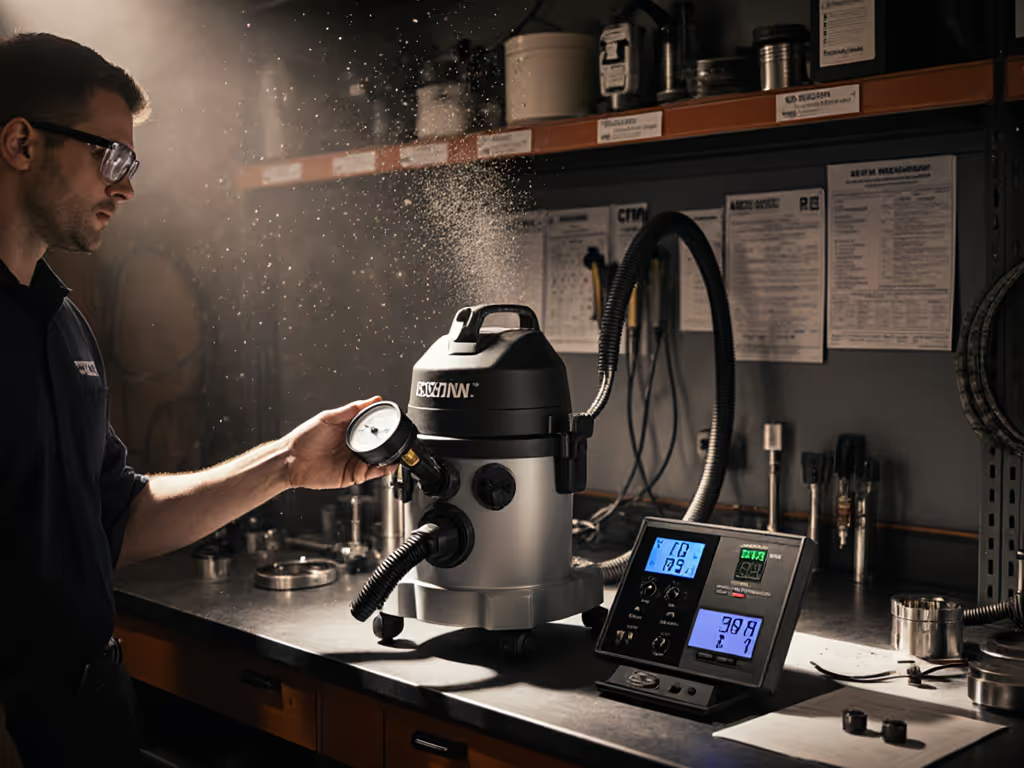
Water lift (also called sealed suction or static pressure) measures how much suction force your motor can generate when the hose is fully blocked. The test is straightforward: technicians attach a sealed tube filled with water to the vacuum inlet and measure how high the motor pulls the water column vertically. The result is expressed in inches of water (in H2O) or inches of mercury. For the underlying principles that tie lift and airflow together, see how shop vac suction works.
A typical good baseline for water lift is around 80-85 inches of water lift. For challenging jobs (heavy sand, stones, or liquids), you want 80-120 inches.
Water lift tells you the motor's ability to overcome resistance. Carpet fibers, filter clogging, long hoses, and wet debris all create resistance. A motor with high water lift can still pull air through a partially clogged filter or dense material. Without lift, you won't pull up dirt from the carpet or heavy debris off the surface.
CFM vs Water Lift: Why Both Matter, And Why Balance Wins
Here's where the physics gets practical: CFM and water lift operate under different conditions, and overshooting one while neglecting the other creates costly failures.
CFM and water lift are measured at different operational points. CFM is measured with the hose open; water lift is measured with the system sealed. A motor can have high peak water lift but weak CFM (meaning it can overcome resistance but won't move much air). Conversely, a motor can have impressive CFM but insufficient lift, leaving you unable to pull debris off the surface or through a filter that's even slightly clogged.
The math confirms this. Airwatts is a composite metric that factors both values: (Water Lift in inches x CFM) / 8.5 = Airwatts. A vacuum with 150 inches water lift and 150 CFM generates 2,647 airwatts. But a vacuum with 250 inches lift and only 50 CFM generates just 1,470 airwatts, less effective overall, even though it looks powerful on the spec sheet.
The lesson: balance is king. For dust extraction and surface prep, aim for a motor that delivers both strong CFM and adequate water lift in proportion. A typical ideal range is 150-300 CFM paired with 80-120 inches of water lift.
How Do These Metrics Affect Real Job Performance?
Let me ground this in scenarios you'll recognize.
Scenario 1: Drywall Sanding with Inadequate CFM
You connect your orbital sander to a vac with 80 CFM and 90 inches water lift. The motor has plenty of lift to overcome your filter's resistance, but it simply can't move the volume of drywall dust your sander generates. Within minutes, your filter clogs. Suction drops. Dust clouds form around the sanding head. Compliance risk spikes. Filter clogging is a silent killer: it doesn't just slow you down; it compounds the filtration problem and pushes uncontained dust into the space.
Scenario 2: Wet Pickup with Insufficient Water Lift
You're running a water mitigation job and your vac has 180 CFM but only 65 inches water lift. The high CFM moves air effectively, but the motor lacks the suction force to overcome water's weight and density. Water pools in the tank or hose rather than rising into the motor. You lose suction, water backs up, and your filter fills with moisture instead of air passing through it. Motor damage follows.
Scenario 3: Long Hose Runs on Job Sites
You're working 40 feet from your vacuum. Long hoses create significant resistance. A balanced motor (150 CFM, 100 inches water lift) maintains suction at the tool end. An underpowered motor (60 CFM, 70 inches lift) loses suction dramatically over distance. The tool won't stick to the surface, and dust escapes containment. For planning long runs and tool ports, learn how hose length and diameter affect suction.
How Does Physics Create These Measurements?
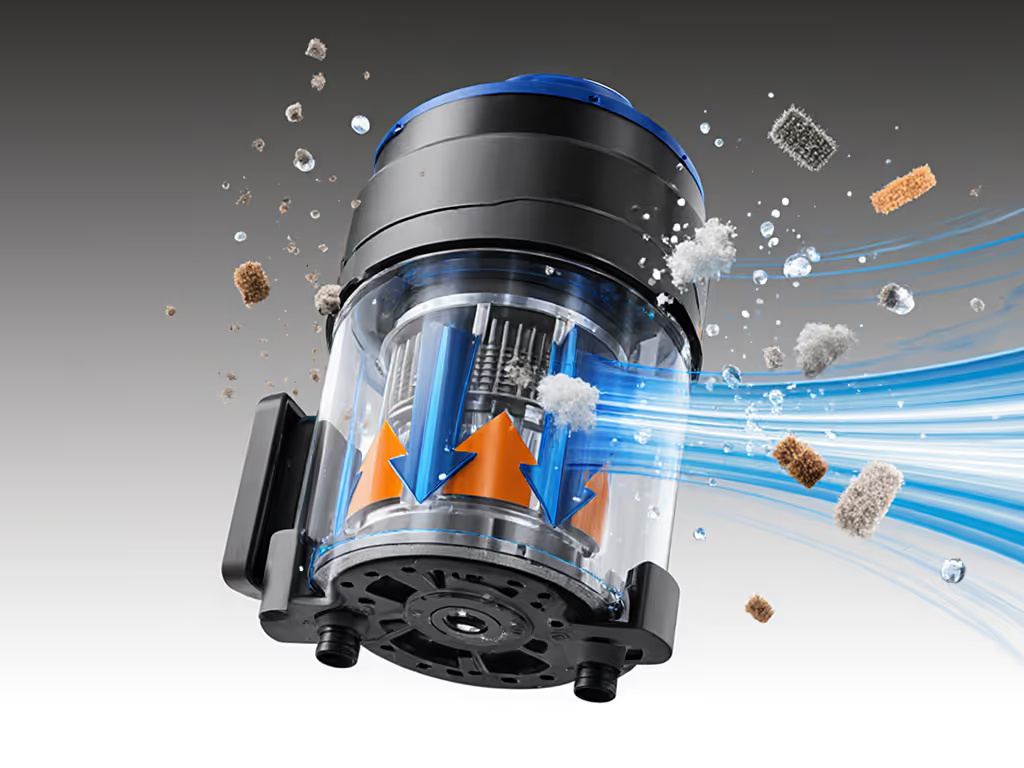
The fundamental principle: pressure difference. Your vacuum motor lowers air pressure inside the system below atmospheric pressure outside. That pressure difference forces air (and attached debris) to flow in.
Think of a straw: you lower pressure in your mouth, and the higher external pressure pushes liquid up through the straw. Vacuums work identically. The motor creates a partial vacuum, external pressure does the work, and air flows toward the low-pressure zone.
CFM represents the motor's capacity to sustain that flow as air encounters resistance (the hose, filter, debris). Water lift measures the motor's capacity to create enough pressure difference to overcome blockages and heavy loads.
Here's the dependency: if your motor creates high lift but can only push air slowly (low CFM), you're moving small volumes against high resistance, fine for sealed applications but useless for carrying dust over distance. If your motor moves large volumes of air (high CFM) but can't overcome resistance (low lift), air rushes through but can't dislodge heavy debris or pull through a filter effectively.
What Should You Actually Look for When Choosing a Vac?
Check both specs, calculate airwatts, and match to your dominant work category:
- General dust extraction (drywall, wood, light demolition): Aim for 150-200 CFM and 80-100 inches water lift. Airwatts should exceed 2,000.
- Heavy debris and wet work (sand, gravel, water mitigation): Push toward 200-300 CFM and 100-120 inches water lift. You need both volume and force.
- Fine dust or HEPA applications (silica, mold, allergen containment): Prioritize water lift alongside your filter choice. A sealed-filtration vac with 90-100 inches lift and 120-150 CFM will maintain suction through a quality HEPA filter without choking.
Avoid the marketing trap: Never rely on peak horsepower or peak amperage alone. Manufacturers often advertise theoretical maximum lift (sealed suction) without mentioning CFM at that state. A vac rated "85 inches water lift" might achieve that only with zero airflow, useless on a real job.
Ignore vague terms like "powerful suction." Demand specs in writing: exact CFM, exact water lift in inches, and ideally the airwatts calculation. If the seller can't provide both metrics, the vac is either undersized or overmarketed.
Containment first; cleanup is the insurance your lungs deserve. When you match CFM and water lift to your actual dust load, you're not just optimizing performance, you're building a system that captures what it promises. That's compliance. That's health. That's professionalism.
Continue Your Exploration
Understanding vacuum performance metrics is the foundation, but the real power comes when you pair the right CFM and water lift with the correct filter media (HEPA vs. cartridge vs. foam), sized hoses, and sealed adapters for your tools. Dive deeper into how filter choice, hose diameter, and pre-separators affect the efficiency of your motor in shop vacs. For a side-by-side breakdown, see our shop vac filter comparison. Document your specs, build a simple labeled kit with verified CFM/lift ratings, and treat vendor spec sheets as compliance evidence, not marketing copy. Your next inspection won't be a surprise.
Related Articles